
Payment model choice
Robots as a Service vs Buying AMRs
Buy, lease or subscribe: compare ownership, service duty, risk and exit terms.
Buying, leasing and robots as a service (RaaS) differ in who owns the AMRs, when you pay, who keeps them running and how you exit. Buying puts the up-front cost and the obsolescence risk on you. Leasing spreads the equipment cost, but you usually still maintain the robots. RaaS bundles robots, maintenance, updates and support into a recurring fee while the provider keeps ownership. Compare what each contract covers and how it ends, not the label.
Step 1
Three ways to pay for AMRs, and who owns what
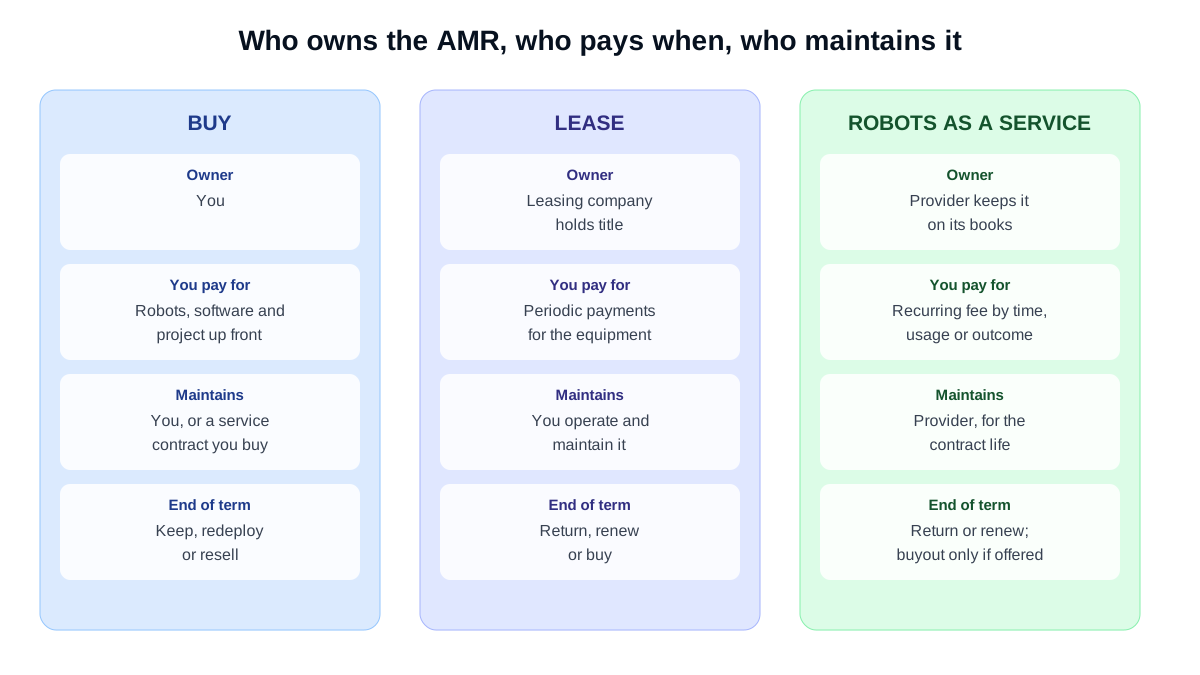
The three models are easy to blur because providers use “lease”, “rental” and “subscription” loosely. The clearest line is ownership plus service duty. In the usual definition, RaaS differs from a lease because the original manufacturer keeps the robot as an asset on its own books and must update and maintain it throughout the contract. In a lease, the leasing company holds legal title, but you operate, maintain and integrate the equipment as if you owned it.
| Model | Who owns the robots | What you pay for | Who maintains them | End of term |
|---|---|---|---|---|
| Buy | You do | The robots, software and project up front | You, or a service contract you buy | You keep, redeploy or resell the robots |
| Lease | The leasing company holds title | Periodic lease payments for the equipment | You operate, maintain and integrate it as if you owned it | Return, renew, or buy at fair market value or a set buyout price |
| Robots as a service | The provider keeps it on its books | A recurring fee by time, usage or outcome | The provider, for the life of the contract | Return or renew; any buyout is whatever the contract says |
Treat the table as the typical pattern, not a guarantee. A lease can come bundled with a service plan, and a RaaS contract can carve out items you might expect to be included. The contract, not the name on it, decides who does what.
Step 2
What changes in the cost structure
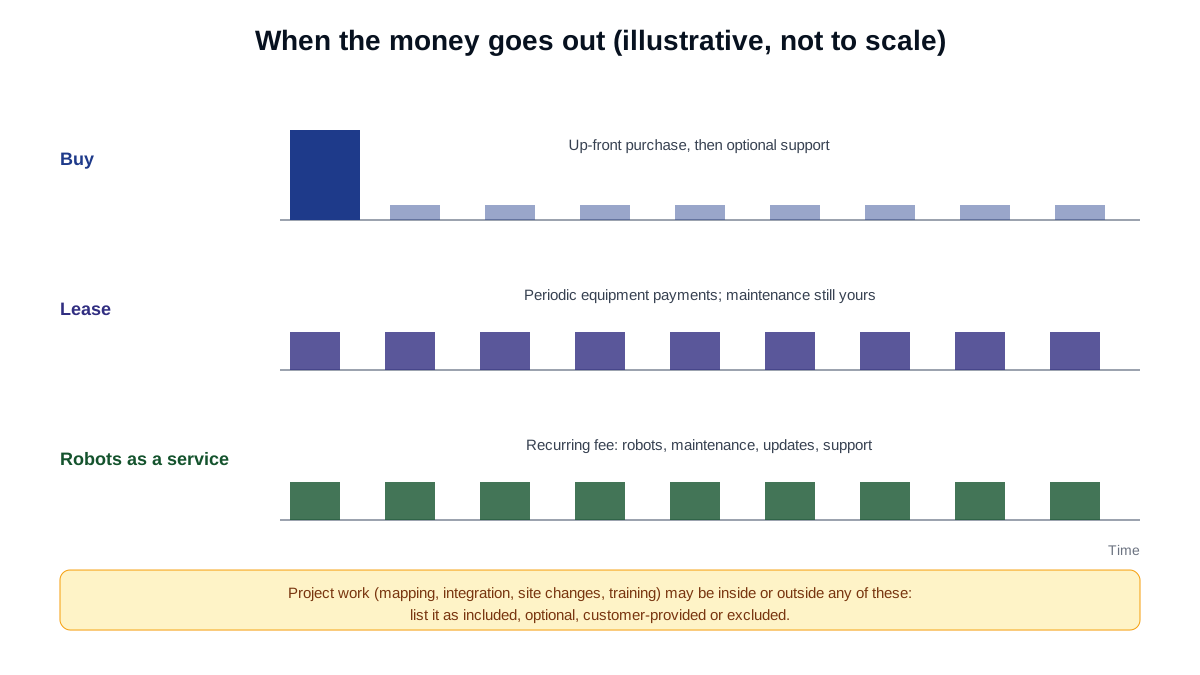
Buying concentrates spending at the start: robots, fleet software, chargers and the project itself, followed by whatever support you choose to pay for. Leasing moves the equipment part into periodic payments. RaaS goes furthest: one distributor describes it as bundling the hardware, the manufacturer warranty, software updates and support into a single recurring fee, and providers price that fee by time (monthly or annual), by usage (for example per hour) or by outcome (for example completed deliveries).
The part that often gets lost is the project work around the robots. Mapping, integration with your WMS or MES, site changes, safety validation and training can be inside the fee, billed once at the start, or left to you, and the answer changes the comparison more than the headline rate. List each item as included, optional, customer-provided or excluded in the same way for every offer; the AMR cost guide shows how to separate setup costs from ongoing costs so a low monthly figure does not hide work that has moved back to your team.
Once both sides are on the same scope, the payback and horizon arithmetic is the same for every model; the AMR ROI calculation guide covers it, with recurring fees entered as recurring costs.
Step 3
Who carries which risk
When you buy, you carry the full up-front cost and the risk that a newer generation arrives before the purchase has been paid off. RaaS shifts that ownership risk to the provider and, because the provider is paid to keep the units working, ties its incentive to uptime. The trade is commitment: you exchange asset risk for contract terms. The table compares buying with RaaS; a lease sits in between, closer to buying on service and closer to RaaS on ownership.
| Risk | If you buy | Under robots as a service |
|---|---|---|
| A newer robot generation arrives | You carry it: the robots may be outdated before they are paid off | Provider-owned robots can be swapped or upgraded if the contract allows it; ask how |
| Robots are down | Your team or your service contract restores them | The provider is paid to keep units working; check how uptime is defined and what happens when it is missed |
| Volume swings with the season | Robots sized for the peak sit idle off-peak | Some providers let you scale units up or down; the notice period and minimum count decide how useful that is |
| The workflow changes | You fund remapping, integration changes and redeployment | Find out whether changes are included or billed as new scope |
| You want to stop | You own an asset you can resell or redeploy | You are bound by the minimum term, notice and any early-termination fee |
Seasonal volume is where RaaS is most often pitched: an industry association blog describes covering seasonal labor gaps without paying for a full system that sits unused the rest of the year. Whether that works for you depends on how quickly units can be added or removed and whether your routes, chargers and integrations can absorb the change. The AMR fleet size calculation shows how far peak and off-peak robot counts actually differ.
Step 4
Service responsibility: read what the fee actually covers
“Maintenance included” can mean very different things. RaaS offers commonly name the robots, software updates, maintenance and support; some providers go further and say they own, operate and maintain the equipment over the contract. Before comparing offers, get written answers to the same questions from each one:
- Response and uptime: how uptime is defined, how it is measured, what response time applies on each shift and what you receive if it is missed.
- Parts and wear items: whether spares, batteries and wheels are included or billed, and where the spares are kept.
- Software: whether fleet software updates are included, who decides when they are installed and how they are tested against your integrations.
- Operation: who runs the fleet day to day, who handles exceptions and who your operators call.
- Damage and misuse: what counts as customer-caused damage and how it is charged.
With a purchase or a plain lease, the same questions still apply; they simply become the scope of a separate service contract, or of your own maintenance team.
Step 5
Exit terms decide the real commitment
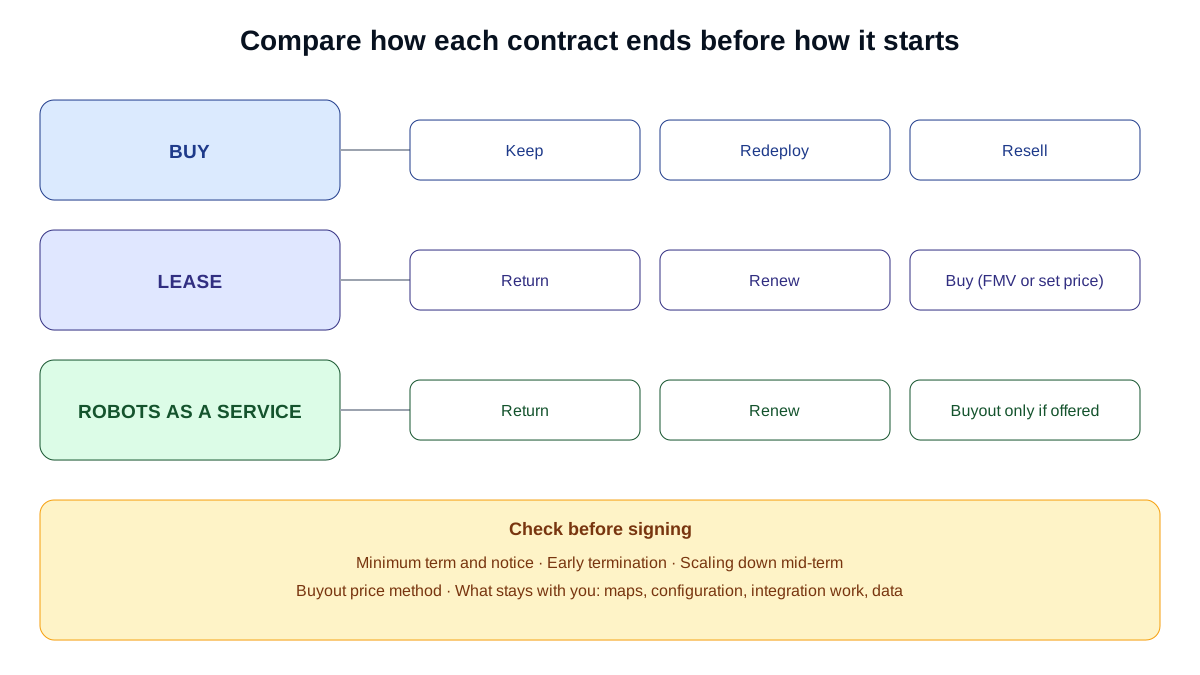
A low entry cost says little about how committed you are. Published RaaS examples run from agreements as short as 24 months to five-year contracts, and leases end in one of three ways: return the equipment, renew the lease, or buy the equipment at fair market value or a predetermined buyout price. Read these terms before the monthly figure:
- Minimum term and notice: the shortest commitment, the notice needed to stop or renew, and whether renewal is automatic.
- Early termination: what you owe if the site closes, the workflow changes or the project is stopped.
- Scaling down: whether units can be returned mid-term and the minimum fleet the fee assumes.
- Buyout: whether you can buy the robots at the end, and how the price is set.
- What stays with you: site maps, route and traffic configuration, integration work and operating data, and what happens to them when the robots leave.
Step 6
When each model tends to fit
- RaaS tends to fit when you are still proving that robots deliver the result you expect, when demand swings with the season, or when you do not have the in-house capability to maintain robots. Vendors present a short pilot on one workflow as a low-risk way in.
- Buying tends to fit a proven, stable, long-term workflow when you have the capital and the support capability, and when the solution is tailored or tightly integrated with your systems.
- Leasing fits when you want ownership-style control and your own maintenance, but prefer to spread the equipment cost or keep the option to return or buy at the end.
Most of these signals come from providers of one model or another, so treat them as starting points, not verdicts. The comparison that settles it is the same scope priced under each model over the same horizon, including what it costs to leave.
Scope
Accounting and tax: a pointer, not advice
RaaS is often sold as moving spending from capital to operating expense. The label on the contract does not settle that. Under US GAAP (ASC 842), a contract is or contains a lease if it conveys the right to control the use of an identified asset for a period of time in exchange for consideration, and service arrangements that use equipment have to be evaluated for an embedded lease. Other frameworks and tax rules differ. Ask your accountant or tax advisor to review the actual contract before you rely on any treatment.
This guide does not quote prices, rates or payback periods, and it does not describe HiO's own commercial terms: this site does not publish a leasing, rental or RaaS program. Provider statements above are quoted as vendor claims, not tested results.
Buyer questions
FAQs
What is robots as a service for AMRs?
Robots as a service (RaaS) is a way of paying for robots through a subscription or usage-based contract instead of buying them. The provider keeps ownership of the robots and, in the usual definition, maintains and updates them for the life of the contract. Fees are typically set by time, by usage or by outcomes such as completed moves.
Is RaaS the same as leasing?
No. Under a lease, a leasing company holds title but you operate, maintain and integrate the equipment as if you owned it, and at the end you return it, renew or buy it. Under RaaS the provider keeps the robot on its own books and stays responsible for maintenance and updates. Individual contracts vary, so read what each one actually assigns to you.
Does a RaaS subscription count as an operating expense?
Do not assume so. RaaS providers often describe the fee as operating spend, but under US GAAP (ASC 842) a contract is or contains a lease if it conveys the right to control the use of an identified asset for a period of time, and service arrangements that use equipment have to be evaluated for that. Ask your accountant or tax advisor to review the actual contract.
Does HiO offer RaaS or leasing?
This site does not publish a leasing, rental or robots-as-a-service program. If you need a particular payment model, ask HiO directly which commercial and service terms can be quoted for your workflow.
Sources
- Definition of a Lease (ASC 842 roadmap) — Deloitte Accounting Research Tool (accounting reference).
- The Rise of Robots-as-a-Service — A3 (Association for Advancing Automation) blog, April 2020.
- Robot as a service — Wikipedia (definition of the business model).
- Robots-as-a-Service vs. Ownership — URG Americas, June 2026 (vendor-authored).
- Robots-as-a-Service (RaaS): A Guide to Robot Subscriptions — Hardfin, August 2025 (vendor-authored).
- Leasing Industrial Robots and Automation Equipment — Crestmont Capital, August 2025 (equipment lender).
- Robots-as-a-Service (RaaS), Robotics-As-A-Service and To Own or to Lease — Formic, inVia Robotics and Prime Robotics (RaaS providers; vendor claims).
Comparing payment models for an AMR project?
Send the workflow, the expected term and how much volume swings across the year, and ask HiO which commercial and service terms it can quote for that scope.
Discuss your project