
Skip to content
HiO Robots

Buyer guide ?AGV vs AMR

AGV vs AMR: What Is the Difference?

Both move material without a driver. The practical difference is how the vehicle navigates, how it reacts to change and what your operation needs to support it.

By iBen Robotics Editorial Team ?Published and reviewed July 23, 2026 ?8 min read

An AGV (automated guided vehicle) and an AMR (autonomous mobile robot) both automate internal transport. In the traditional sense, AGVs follow defined guidance while AMRs use onboard sensing and mapping to navigate more flexibly. That distinction is useful, but it is not the whole buying decision: modern products overlap, and the workflow matters more than the name on a brochure.

Start with the route you need to automate, then compare how each candidate vehicle localizes, plans paths, handles obstructions, integrates with your systems and fits your safety design.
The short answer

The difference is navigation and decision-making, not the job they do.

Traditional AGVs receive their guidance from the route: a wire, magnetic tape, painted line, reflectors, markers or a fixed programmed path. That can make movement exceptionally repeatable when the facility and task stay consistent.

AMRs carry more of the navigation intelligence onboard. They use sensors such as LiDAR, cameras and encoders to localize against a map, understand their immediate surroundings and choose a path within fleet and safety rules. When a route changes, the change is often made in software rather than by modifying the floor.

However, neither category should be treated as a promise of a particular capability. Some newer AGVs navigate without tape; most AMRs still use planned virtual routes, traffic rules and controlled zones. Ask for a demonstration of the actual operating behaviour you need.

Side-by-side

AGV vs AMR comparison

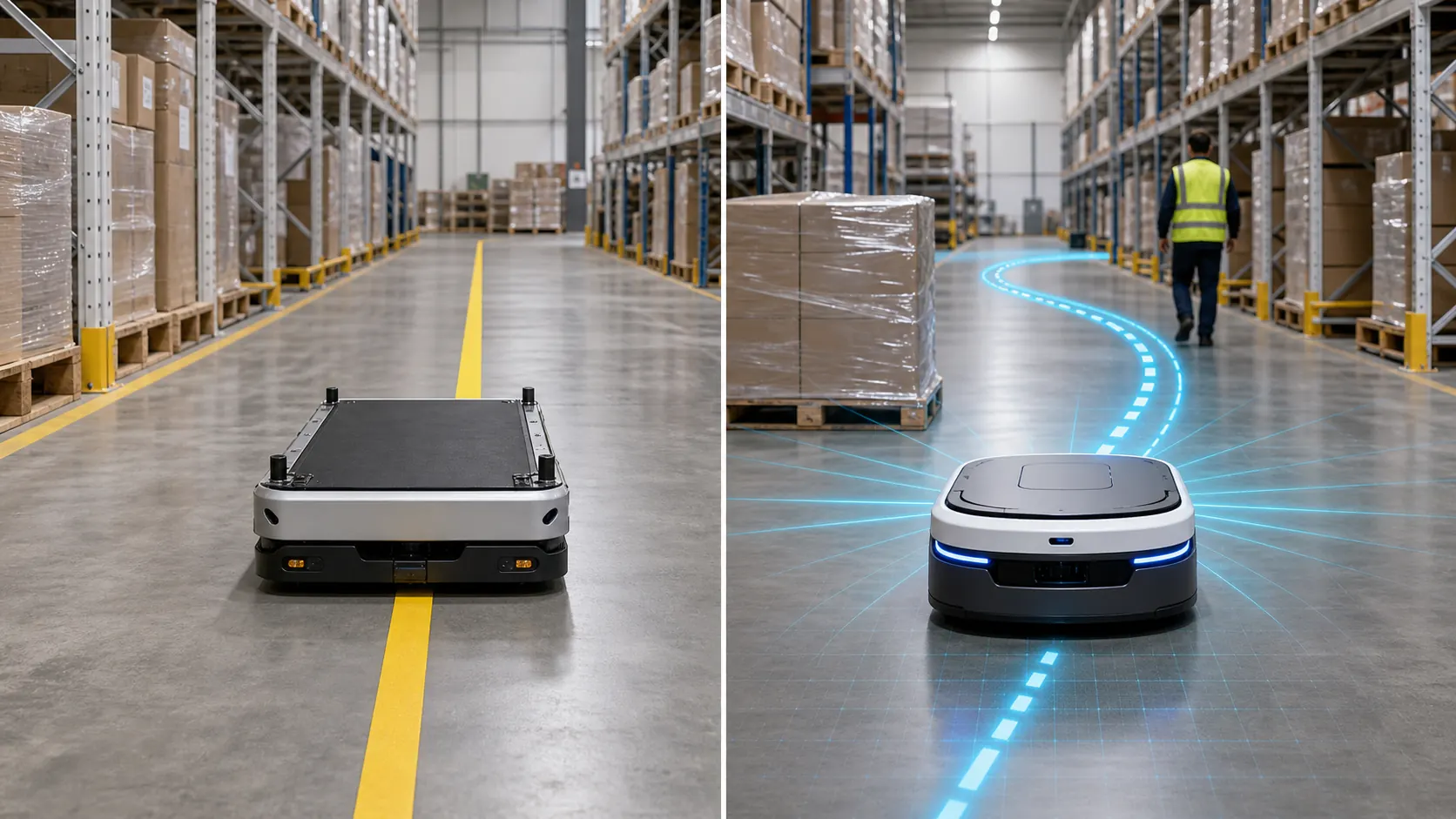
Split warehouse scene comparing a guided vehicle following yellow floor tape with an autonomous mobile robot using a sensor-guided route around a pallet.
Traditional guided vehicles commonly follow defined route guidance. AMRs use onboard sensing and mapping to navigate within configured operating rules and can respond to temporary obstructions.
Comparison of traditional automated guided vehicles and autonomous mobile robots
FactorTraditional AGVAMR
How it navigatesUsually follows a defined guide, such as tape, wire, reflectors, markers or a programmed route.Typically localizes with onboard sensors and a map, then plans its path within operating rules.
Changing a routeMay require changing physical guidance or reprogramming a fixed route, depending on the system.Often means updating a map, waypoint, zone or fleet rule in software, then validating the new workflow.
Response to a blocked aisleMay stop, wait or follow a configured avoidance behaviour.Can detect a temporary obstruction and may slow, wait or choose an approved alternate path.
Facility infrastructureTraditional systems commonly use floor or environmental guidance.Can use natural features and onboard sensing, reducing the need for route-specific floor guidance.
Best operating fitHighly repeatable transport on stable, predictable routes.Operations with changing layouts, mixed traffic or evolving task priorities.

When a traditional AGV can be the right fit

A guided solution deserves serious consideration when transport is high-volume, the path is stable, handoffs are consistent and predictable cycle timing matters more than frequent reconfiguration.

  • One or a few repeatable point-to-point routes
  • A facility layout unlikely to change soon
  • Defined lanes or controlled traffic conditions

When an AMR can be the right fit

An AMR is usually compelling when a facility is alive with changing priorities, shared aisles and routes that cannot be treated as permanent infrastructure.

  • Layouts, dock assignments or pickup points change regularly
  • People, forklifts and robots share the same operating area
  • You want to start with a focused workflow and scale the fleet

Integration matters

A mobile robot is part of a system, not a standalone vehicle.

Your WMS, MES or ERP may create work; fleet software assigns it; charging, doors and elevators can affect the route; and operators need a clear way to recover exceptions. Interoperability needs to be checked rather than assumed. VDA 5050 is an open communication interface between mobile robots and a master control system, but support for a standard must be confirmed at the version and function level for your project.

Buyer checklist

Evaluate the workflow before you compare vehicle specifications.

01

Load and carrier: weight, dimensions, centre of gravity and how the robot picks up or hands off the load.

02

Flow: pickup and drop-off points, trips per shift, service-time limits and peak demand.

03

Environment: aisle width, slopes, doors, lifts, floor condition, network coverage and shared traffic.

04

Interfaces: WMS, MES, ERP, conveyors, elevators, doors and the dispatch logic that will create tasks.

05

Safety case: risk assessment, operating zones, pedestrian interaction, emergency procedures and acceptance testing.

Run representative load, route and traffic testsot only a clear-floor demo. A good pilot measures completed tasks, exception recovery, handoff reliability and the impact on the people who run the process.

Questions buyers ask

AGV and AMR FAQ

Is an AMR always better than an AGV?

No. An AMR is often a better fit where routes, layouts or traffic conditions change, but a guided vehicle can be a practical choice for a very stable, repetitive transport loop. The right choice comes from the workflow, not the label.

Can an AGV use SLAM or operate without tape?

Yes. The terminology overlaps in the market. Some vehicles sold as AGVs use laser or natural-feature navigation, while AMRs still operate with preferred virtual routes and traffic rules. Ask suppliers to describe the actual localization, route-planning and obstacle-handling behaviour.

Do AMRs safely drive around people and forklifts?

AMRs can sense and respond to obstacles, but that does not replace a site-specific risk assessment or safe operating design. Define pedestrian crossings, speed zones, visibility, handoff points and recovery procedures before go-live.

Can one fleet include different mobile robot brands?

It can be possible when the fleet and vehicles support a common interface, but compatibility still needs validation. VDA 5050 defines a communication interface between mobile robots and a master control system; confirm the supported version and functions in the project scope.

What information should I send for an AGV or AMR quote?

Provide load details, drawings or video of the route, pickup and drop-off method, trip volume by shift, traffic constraints, available charging time and the systems that need to exchange tasks or status.

Map your material flow with an engineer.

Share your load, route, throughput and integration requirements. We will help you define a practical AMR scope for your operation.

Review your workflow