
Warehouse architecture guide
Autonomous Mobile Robots or Conveyors? A Warehouse Automation Decision Matrix
Choose flexible mobile flow, fixed flow or a hybrid from measured demand and change—not from a generic technology scorecard.
Use conveyors when a defined load must move repeatedly through stable points at an engineered rate. Use AMRs when origins, destinations, routes, product mix or capacity must change without rebuilding a fixed path. Use both when a high-rate stable trunk needs flexible first- or last-meter transport. The answer requires measured rate, peaks, buffers, route stability, floor space, handoffs, downtime and change cost.
Architecture first
Do not compare AMRs and conveyors without a common flow definition
Define the load unit, weight and dimensions; each origin and destination; time-phased moves; peak window; required completion time; accumulation or buffer; handoff confirmation; operating hours; availability target; people and vehicle traffic; future changes; and what happens during a stop. MHI’s conveyor guidance starts from load type, origin/destination, throughput, existing equipment and cost. Apply the same input discipline to an AMR proposal.
| Decision | AMR-led | Conveyor-led | Hybrid |
|---|---|---|---|
| Flow pattern | Changing origins/destinations or routes | Stable repeated path | Stable trunk plus changing branches |
| Capacity model | Fleet, cycle time, traffic and charging | Speed, spacing, accumulation and sortation | Separate trunk and mobile capacity, then test handoffs |
| Building impact | Charging, traffic controls, network and stations | Supports, guarding, power, controls and fixed footprint | Both, concentrated at transfer points |
| Change method | Map, task, station and fleet changes | Mechanical/control redesign and installation | Keep stable core; change mobile edges |
| Failure behavior | Tasks can reroute if capacity remains | A failed segment can stop downstream flow | Buffers isolate the two failure domains |
Input 1 · demand
Model time-phased throughput, peaks and buffers
Annual volume and average hourly volume hide the architecture problem. Use 15- or 30-minute demand windows, simultaneous origins, delivery deadlines and restart requirements. For AMRs, measure complete loaded and empty travel, pickup/drop-off, waits, charging and availability. For conveyors, engineer speed, load spacing, accumulation, merges, sortation, induction and downstream capacity.
A conveyor can move large volumes rapidly along its designed flow, but upstream starvation or downstream blockage still controls delivered throughput. An AMR fleet can add vehicles, but aisle congestion and station queues can make the next robot add little capacity. Use the AMR fleet-size guide for the mobile calculation.
Input 2 · flow stability
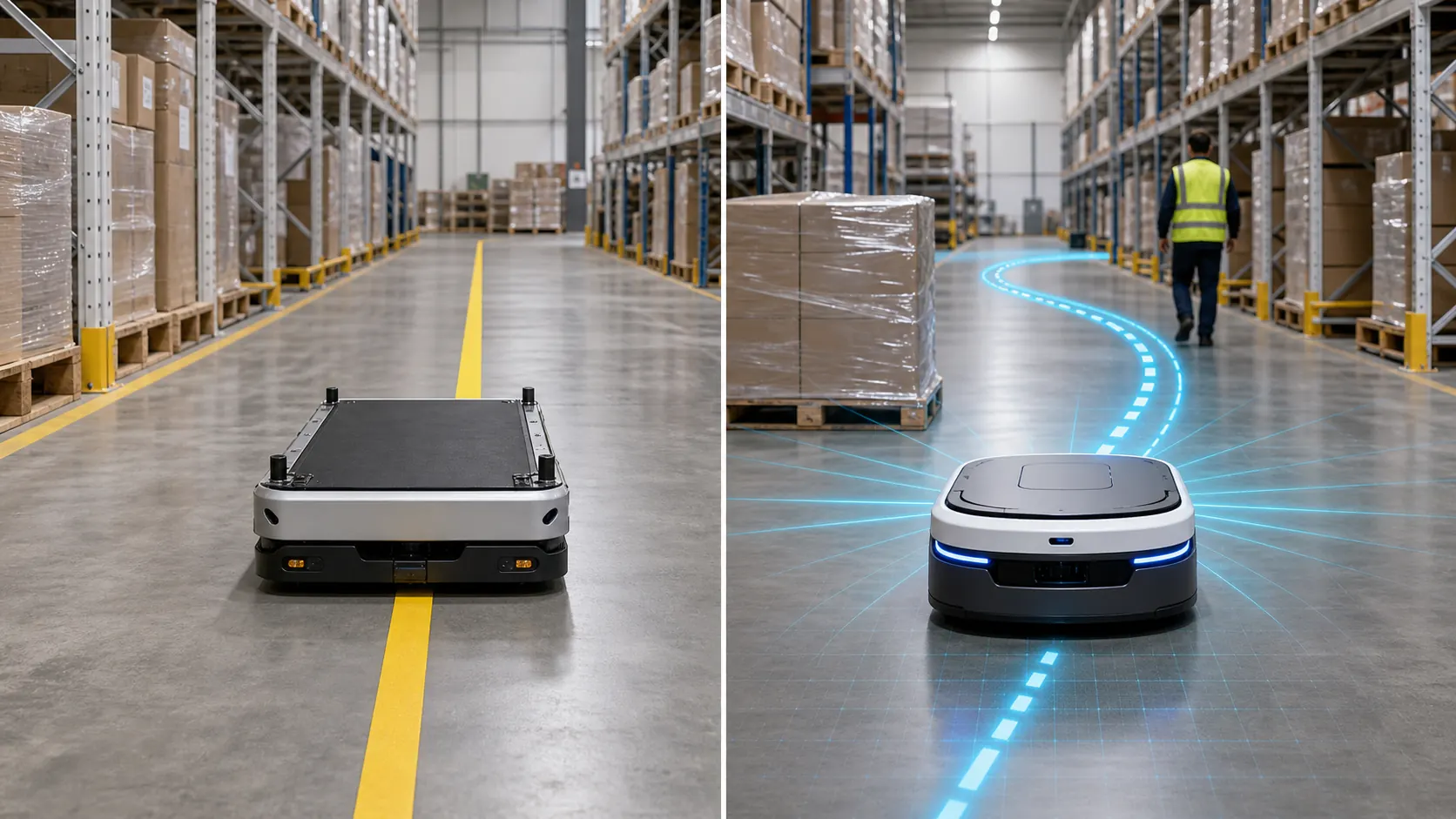
Choose fixed flow when the path is stable and mobile flow when change is real
A stable line between fixed points can justify conveyor supports, guarding, power and controls because the flow will repay that infrastructure. AMRs become stronger when cells move, destinations change, seasonal capacity varies, aisles serve multiple flows or a staged pilot is necessary.
Flexibility is not free. AMRs need controlled maps, traffic rules, network coverage, charging, fleet orchestration, safe operating zones and disciplined station changes. Conversely, a conveyor is not inflexible in every sense: modular sections and controls can be changed, but the cost and outage must be planned. Record how often the facility actually changes and what each change costs.
Input 3 · facility
Price the footprint, aisle sharing and building work
Map supports, guarding, maintenance access, emergency egress, vertical transitions, controls, accumulation and operator stations for conveyors. Map travel lanes, passing points, pedestrian crossings, pickup/drop-off, charging and recovery areas for AMRs. Mobile does not mean zero footprint, and fixed does not mean every aisle is lost.
Change-cost rule
Cost one realistic next-year change: move a station, add a destination, increase a peak, change the load or keep operating during construction. A generic flexibility score cannot replace that scenario.
Input 4 · resilience
Design degraded operation before comparing availability
Map each failure domain: vehicle, charger, network, fleet manager, station, conveyor zone, sensor, motor, sorter, PLC, upstream line and downstream line. Ask whether work can reroute, buffer, continue manually or stop. State spare strategy, response time, safe restart and the operational owner.
Safety is a system condition. ISO 3691-4:2023 covers driverless industrial trucks including AMRs and notes that operating-zone condition significantly affects safe operation. Apply the AMR safety standards checklist to the mobile operating zone. Conveyors need their own machine, guarding and functional-safety review under the applicable project standards.
Architecture option
Use hybrid flow when each technology owns its strongest segment
A conveyor can own a stable accumulation, sortation or high-rate trunk. AMRs can connect changing production cells, storage zones or exception lanes. The transfer must be engineered as a station with load geometry, sensors, confirmation, queue capacity, safe access and recovery—not treated as an invisible boundary.
Next step
Build a pilot-ready architecture brief
- 01Map loads, origins, destinations, time-phased demand and buffers.
- 02Measure complete mobile cycles and engineer fixed-flow spacing and accumulation.
- 03Record route stability, space, building work and one realistic future change.
- 04Define degraded operation, safety review, interfaces, evidence owners and acceptance tests.
After architecture selection, use the AMR integration guide for the gated site-survey and acceptance path.
Buyer questions
FAQs
Are AMRs better than conveyors?
Neither is universally better. AMRs favor changing routes and staged scale; conveyors favor stable paths and engineered continuous flow. Measure the load, origin, destination, rate, peaks, buffers and change frequency.
At what throughput should we choose a conveyor?
There is no universal moves-per-hour cutoff. Conveyor capacity depends on load, spacing, accumulation, merges, sortation and downtime; AMR capacity depends on cycle time, traffic, charging, handoffs and fleet availability.
Can AMRs replace every conveyor?
No. High-rate stable transfer, sortation and accumulation can remain strong fixed-automation cases. AMRs may serve changing origins or destinations and feed a fixed line.
When is a hybrid system best?
Use a hybrid when fixed equipment should own a stable high-rate segment while AMRs connect variable stations, buffer areas or changing routes.
What data belongs in a pilot?
Use time-phased demand, complete cycle time, queue and buffer behavior, blocked-route recovery, handoff success, charging, interface states, safety-zone tests and downtime.
Sources
Ready to test the architecture?
Share the load, routes, time-phased moves, peaks, buffers, building constraints and expected changes. HiO can help frame an AMR or hybrid pilot around measured evidence.
Submit the flow brief