
Vehicle type choice
Autonomous Forklift vs AMR
Fork, lift-under or tugger: choose from where each load is picked up and set down.
Pick the vehicle by how the load is picked up and set down, not by the label. Choose an autonomous forklift when pallets have to come off the floor or go onto rack levels or block stacks, because forks on a mast are what reach those positions. Choose a lift-under or top-module AMR when loads can wait on stands, racks or carriers at a fixed height and the move is horizontal. Choose a tugger when many wheeled carts follow the same route with several stops. An autonomous pallet jack sits in between: forks, but floor to floor. Many sites end up running more than one type.
Step 1
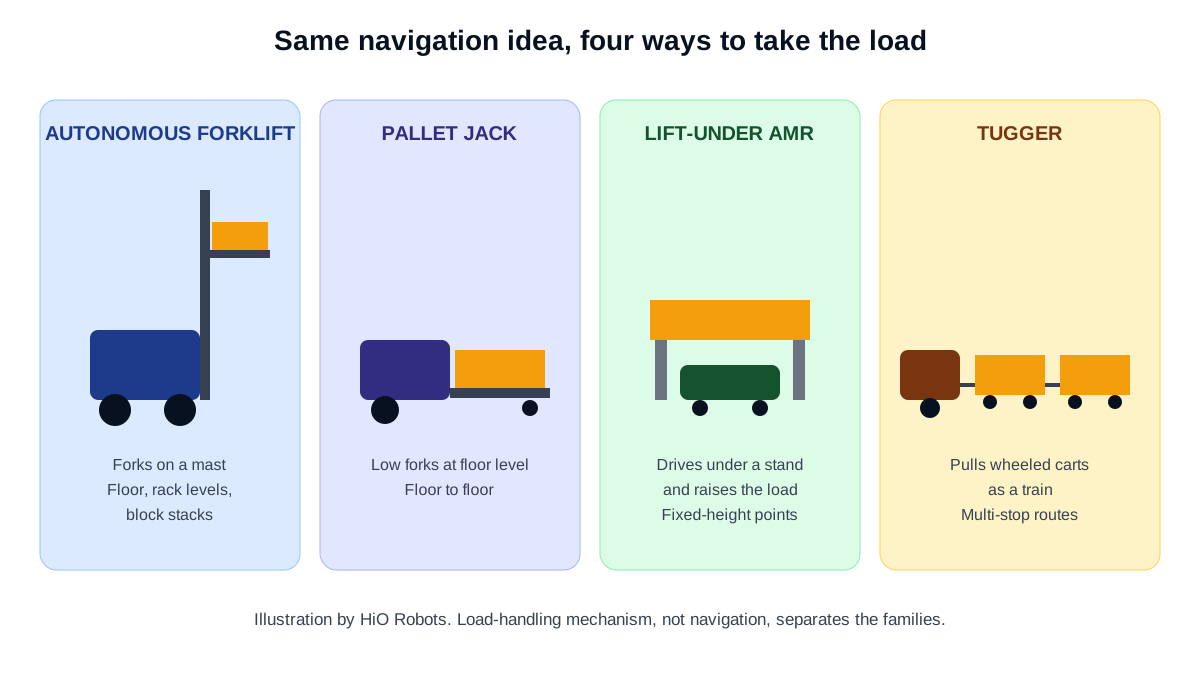
Four vehicle families, sorted by how they handle the load
“Autonomous forklift vs AMR” sounds like a navigation question, but most autonomous forklifts navigate much like AMRs do: KUKA, for example, lists SLAM-based mapping and LiDAR-based obstacle detection for its autonomous forklifts. The difference that decides the project is the load-handling mechanism. An automated forklift carries a mast, forks and a hydraulic lift for pallet handling; a lift-under AMR raises the load from below; a tugger pulls wheeled carts.
| Vehicle family | How it takes the load | Where it can set it down | One published example |
|---|---|---|---|
| Autonomous forklift (counterbalance, stacker) | Forks on a mast with a hydraulic lift | Floor, rack levels, block stacks | KUKA lists a counterbalance model at 1,500 kg and 3 m lift height and a pallet stacker at 1,500 kg and 2.5 m (vendor figures) |
| Autonomous pallet jack | Low forks enter the pallet at floor level | Floor to floor | MiR describes its MiR1200 Pallet Jack as detecting, picking up and delivering EU pallets up to 1,200 kg (vendor figures) |
| Lift-under or top-module AMR | Drives under the load and raises it from below | A stand, rack or carrier at a fixed height | MiR's Pallet Lift 1350 raises and lowers EU pallets up to 1,250 kg from the MiR Pallet Rack (vendor figures) |
| Tugger | Hitches to wheeled carts and pulls them as a train | Wherever the carts are parked | Seegrid rates its Tow Tractor S7 at up to 10,000 lb and says it is limited by weight, not train length (vendor figures) |
The examples are single vendor data points to show what each family looks like, not a shortlist or a ranking. Other products in each family have different ratings.
Step 2
Start from the pick and drop points, not the vehicle
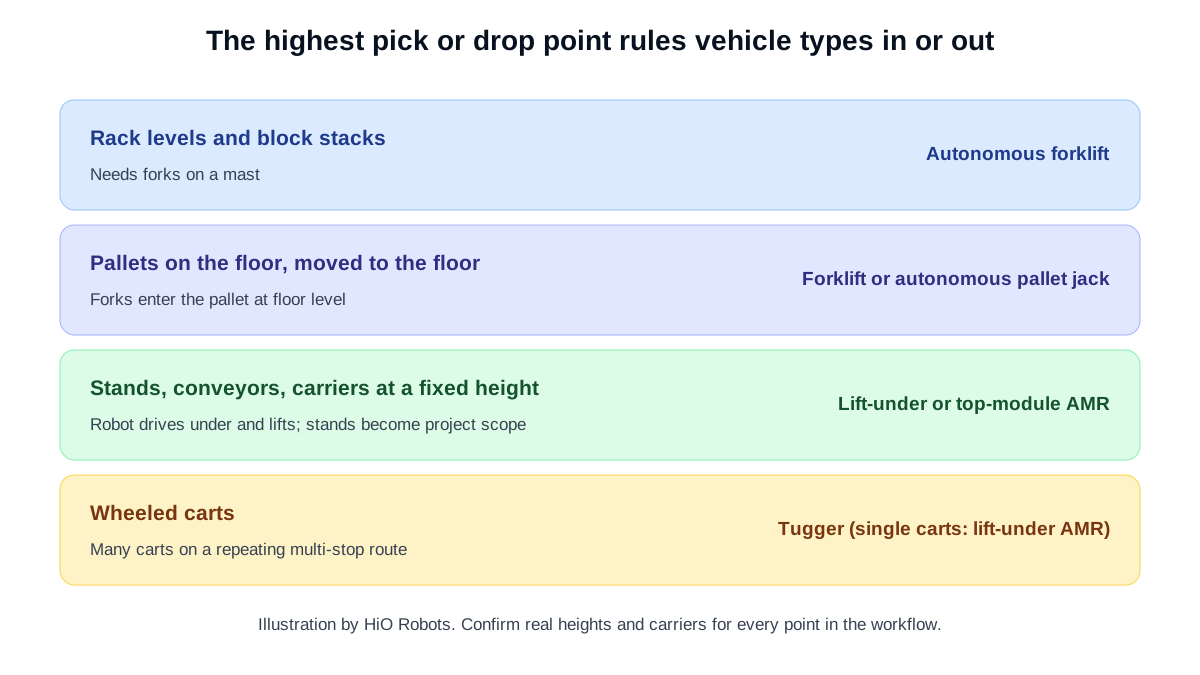
List every point where a load is picked up or set down and note its height. That list usually makes the decision on its own.
- Rack levels and block stacks need forks on a mast. Integrator guidance is direct: forklifts suit racking operations and can pick a pallet from the floor, place it on a rack or retrieve it from a specified height, and they are the choice when pallets need to go onto high racks.
- Pallets on the floor, moved to another floor position can be handled by an autonomous pallet jack, which picks up and puts down pallets at floor level without extra racks.
- Stands, conveyors and carriers at a fixed height suit a lift-under or top-module AMR. The same guidance notes that an AMR may need a station or attachment for load transfer and that its lifting height may be limited by the top module.
- Wheeled carts are tugger territory, or a lift-under AMR if carts are moved one at a time.
If most moves are horizontal and short, with loads already presented at a fixed height, a compact AMR is usually the simpler fit. If the flow ends in racking, trailer unloading or pallet putaway, plan around forks.
Step 3
Six questions that decide the vehicle type
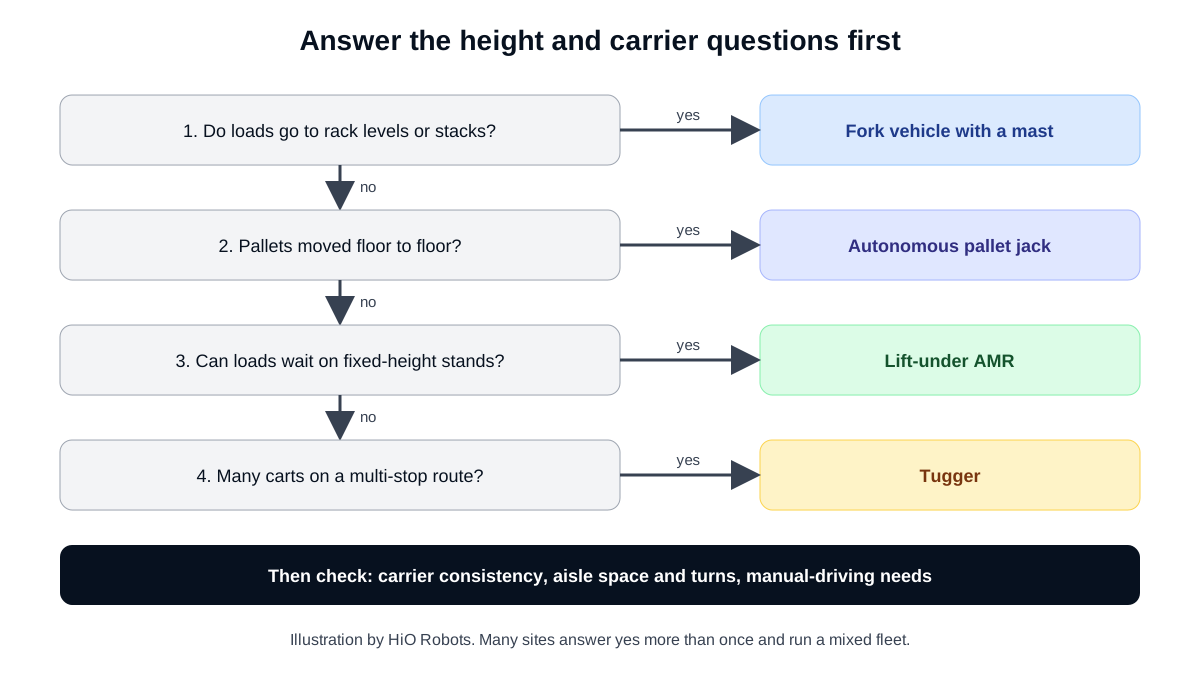
Weight matters, but only as one input: first confirm the load fits the family, then size the model. These six questions separate the families before you compare products.
| Question | How it points to a vehicle type | Evidence to collect |
|---|---|---|
| Where is the load picked up and set down? | Rack levels, block stacks or pallets on the floor point to forks. Fixed-height stands, conveyors or carts open up lift-under AMRs and tuggers. | Drawings or photos of every pick and drop point, with heights |
| Can you add stands or change how loads are presented? | A lift-under AMR needs the load raised to a height it can drive beneath. Stands and rack positions are then part of the project scope. | The number of stands, where they go and who supplies them |
| What carrier moves, and how consistent is it? | Fork vehicles have to find and enter pallets. Research on autonomous forklifts reports pallet skew of up to 15 degrees, overhanging loads and shrink-wrap as open perception problems. | A pickup test with your real pallets, including worn and wrapped ones |
| How many stops does one trip serve? | One load between two points suits a pallet vehicle. Several carts along a repeating route with many stops suits a tugger. | Trips per shift, stops per trip and the route map |
| How much space do aisles and turns leave? | Fork vehicles may need more room because of the load and fork structure. Cart trains need the route and cart design checked for stability. | Aisle widths, turning points and cart dimensions on the actual route |
| Does a person ever need to drive it? | An automated forklift redeveloped from a manual truck can often be driven manually. A vehicle designed only for autonomous use cannot. | Which exceptions are handled by manual driving and which by recovery |
The carrier question deserves extra time. A 2026 review of 122 papers on autonomous forklifts describes pallet detection as complicated by pose variations of up to 15 degrees of skew, partial occlusion from overhanging loads and shrink-wrap, and calls for better handling of damaged pallets and failed fork insertions. A demo with a clean, square pallet does not tell you how your worst pallets will behave.
Step 4
Expect a mixed fleet, and plan the handoffs
In many facilities the answer is not forklift or AMR but both: forks for the receiving, putaway and rack end of the flow, lift-under AMRs or tuggers for the horizontal moves into production or packing. The decision then shifts to where one vehicle hands the load to the next, which usually means a stand, a conveyor or a floor position both can reach.
For reference, HiO's own lineup covers two of these families: the X300L for under-rack lifting and the X300B-L for flat-top lifting with a 60 mm lift, and the fork-style X15T for autonomous pallet transport rated at 1,500 kg. This site does not publish X15T lift heights, so treat rack work as something to confirm in writing rather than assume. To compare payload classes and configurations, see the X Series AMR robots.
Step 5
What to test before you commit to a type
- Fork vehicles: pick and drop at the highest and lowest real positions, with your own pallets, including wrapped, overhanging and worn ones.
- Lift-under AMRs: docking under the actual stands or carts, and what happens when a stand is already occupied or a load sits off-center.
- Tuggers: the full cart train through the tightest turns on the route, and hitching and unhitching at each stop, whether by a person or an automatic hitch.
- All types: shared-aisle behavior around people and other vehicles, and recovery when a pick fails.
Once the type is settled, the AMR fleet size calculation turns cycle times into a vehicle count, and the AMR safety standards guide covers the standards and risk assessment that apply to driverless vehicles, including ones that lift loads.
Scope
What this guide leaves to other pages
This guide compares vehicle families by how they handle loads. The navigation difference between guided vehicles and mobile robots is covered in AGV vs AMR. It does not rank vendors, quote prices or pick a payload class, and the vendor figures above are published claims, not tested results. It is not safety advice.
Buyer questions
FAQs
Is an autonomous forklift a type of AMR?
The labels overlap. Many autonomous forklifts navigate the way AMRs do, with SLAM mapping and LiDAR obstacle detection, so the practical difference is load handling rather than navigation. Some are manual forklifts redeveloped by their maker to run autonomously and can still be driven by a person; others are forked vehicles that were never designed to be driven manually.
Can a lift-under AMR pick a pallet up off the floor?
Usually not on its own. A lift-under or top-module AMR raises the load from underneath, so the pallet or cart has to sit on a stand, rack or carrier that the robot can drive beneath. Picking a pallet directly off the floor is what fork-type vehicles do, including autonomous pallet jacks.
When is an autonomous tugger the better choice?
When many wheeled carts travel the same route with several drop-off and pickup points, such as parts-to-line delivery. A tugger pulls a cart train, so one trip can serve several stops. The route, turns and cart design have to be evaluated for stability, and hitching can be manual or automatic.
Does HiO make an autonomous forklift?
HiO's published lineup includes the fork-style X15T for autonomous pallet transport, rated at 1,500 kg, alongside lift-under and flat-top lifting AMRs such as the X300L and X300B-L. HiO does not publish X15T lift heights on this site, so if your workflow involves rack levels, ask for the pick and drop heights in writing for your pallets.
Sources
- Autonomous Forklifts for Warehouse Automation: A Comprehensive Review — A. D. Patil and S. Farzan, Robotics 15(2), 30, 2026 (peer-reviewed review).
- AMR vs. Forklift Automation Comparison — Bluepath Robotics, August 2026 (integrator-authored).
- Automated Forklift vs AGV/AMR: Choosing the Right Autonomous Lift — Racklify encyclopedia, updated September 2026.
- Automated Forklifts vs Forked AGVs — ANT driven (vendor-authored).
- Autonomous forklifts, MiR1200 Pallet Jack, MiR Pallet Lift 1350 and Seegrid Tow Tractor S7 — manufacturer product pages (vendor claims).
- An Expert's Guide to Tugger AGV Systems — MasterMover (vendor-authored).
Not sure which vehicle type fits?
Send the pick and drop points with their heights, the carriers and the route, and ask HiO which part of the flow its robots can take on and what they cannot.
Review your material flow